




Applied research for your quality control
Data and approach. Images of healthy products provide a reference for an anomaly score and a map of suspicious areas.
Observations. The examples detect and locate some anomalies: printing defects, holes in packaging and scratches.
Project support. Starting with your images and quality criteria, we help you adapt image capture, calibration, and performance monitoring to prepare your production rollout.
Explore our computer vision work in France and our visual quality inspection solution.
Industrial quality inspection is scaling up. Where visual checks historically relied on fixed settings and human inspectors, modern lines now require systems that absorb variability (material, lighting, positioning, throughput) while remaining auditable and deployable.
In that context, computer vision is not only about “catching a defect”; it is about speeding up decisions, standardizing control, and reducing iteration cost when products, packaging, or lines evolve.
At ARCY, part of our R&D is dedicated to quality defect detection with a pragmatic approach: deliver a robust proof of value quickly, then harden it progressively for production.
Anomaly detection for quality inspection
Anomaly detection uses images of healthy products as a reference to identify differences. An anomaly score and a visual map locate areas to examine, providing practical information to guide inspection and prepare quality control on your line.
An approach tailored to your production line
Each project starts with your products and their image capture conditions. Position, lighting, and throughput guide the selection of reference images and the preparation of the vision system.
This approach connects research experiments with your quality criteria to build an inspection process that serves your teams.
Practical examples of detected defects
Our experiments illustrate the detection and localization of several types of anomalies. The visualizations make it possible to examine highlighted areas and relate the observations to inspection criteria.
On typical cases, the pipeline highlights print defects and hole-like anomalies on packaging products, as well as fine defects on another set (small localized defect, scratch).
Image capture prepared for your products
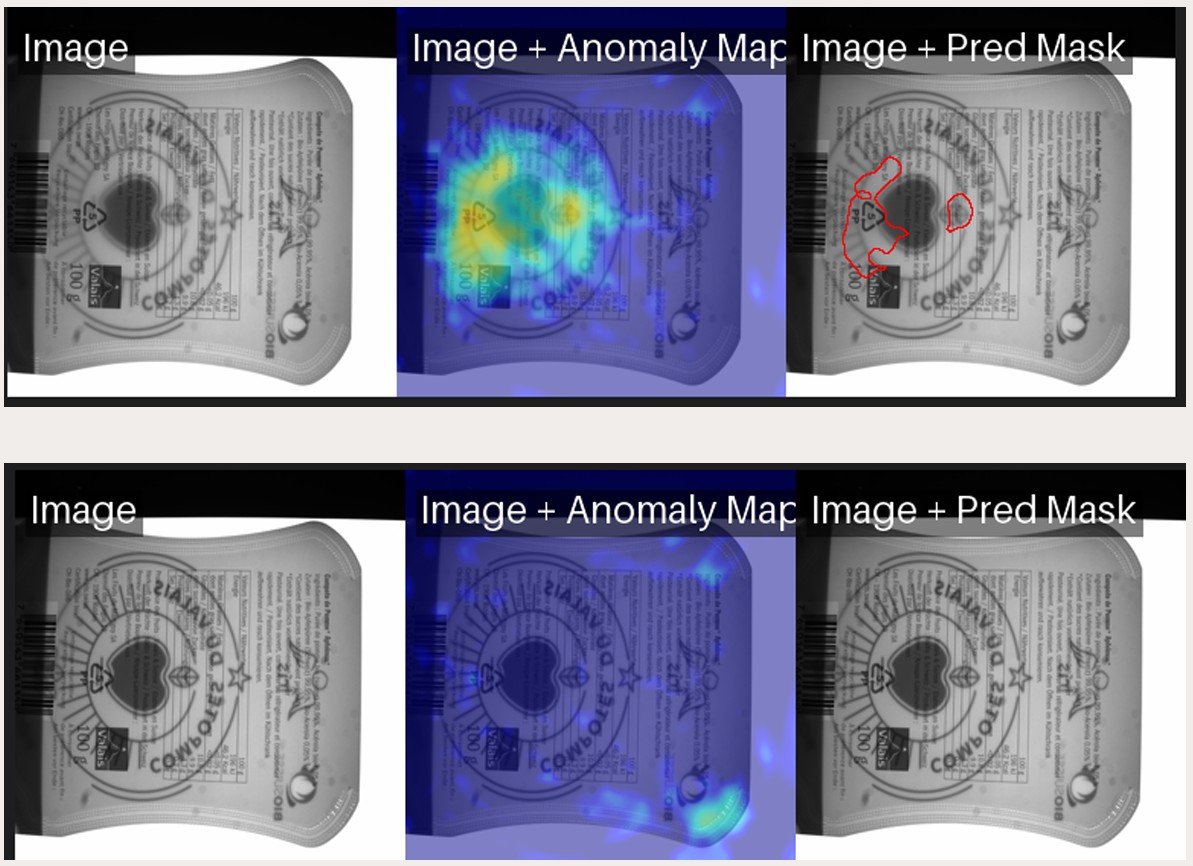
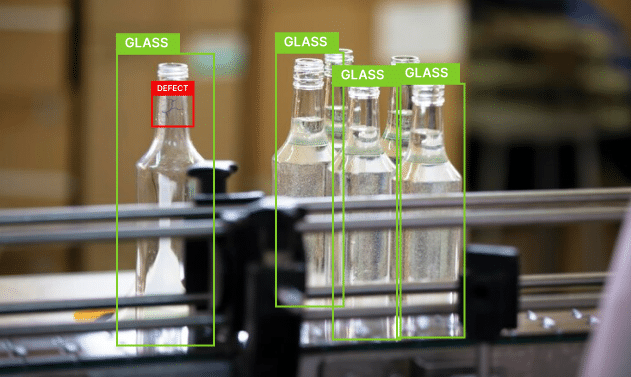
Image preparation allows products to be compared under consistent conditions. Position, orientation, and lighting are included in the project scope.
The model is part of a complete vision workflow, from image capture to the visualization of detected areas.
Calibration, image alignment, and reference selection are among the elements we work on with your teams to adapt this workflow to your products.
Support on the path to production
We propose a project built around images from your site, your inspection criteria, and your performance objectives. Experiments help define the next steps with your quality teams.
Deployment preparation combines image capture, calibration, and performance monitoring to connect experimental results with your daily operations.
Representative images of your products provide the foundation for this work. Synthetic data can complement them according to the needs of the project.
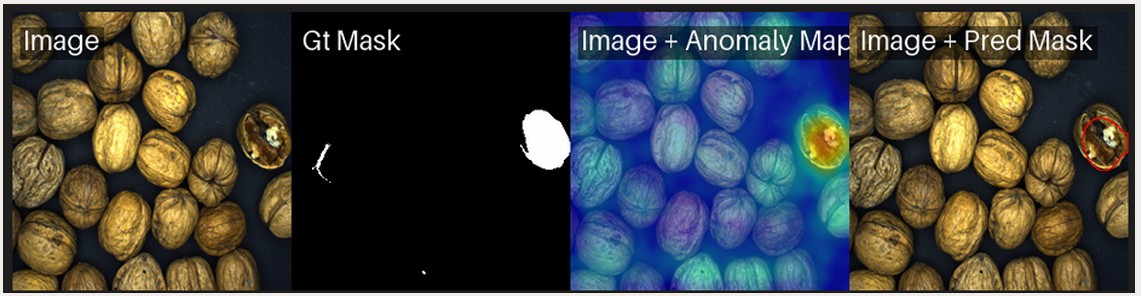
Defect detection on nuts
In this example, we show a prediction mark on nuts in a defect detection setting.
Interested in applying anomaly detection to your products? Let’s discuss your images, quality criteria, and the steps of a project tailored to your line.